Animal Kinhood Wild animals Least Concern
12 min read 9 chapters Live · Kvaløya
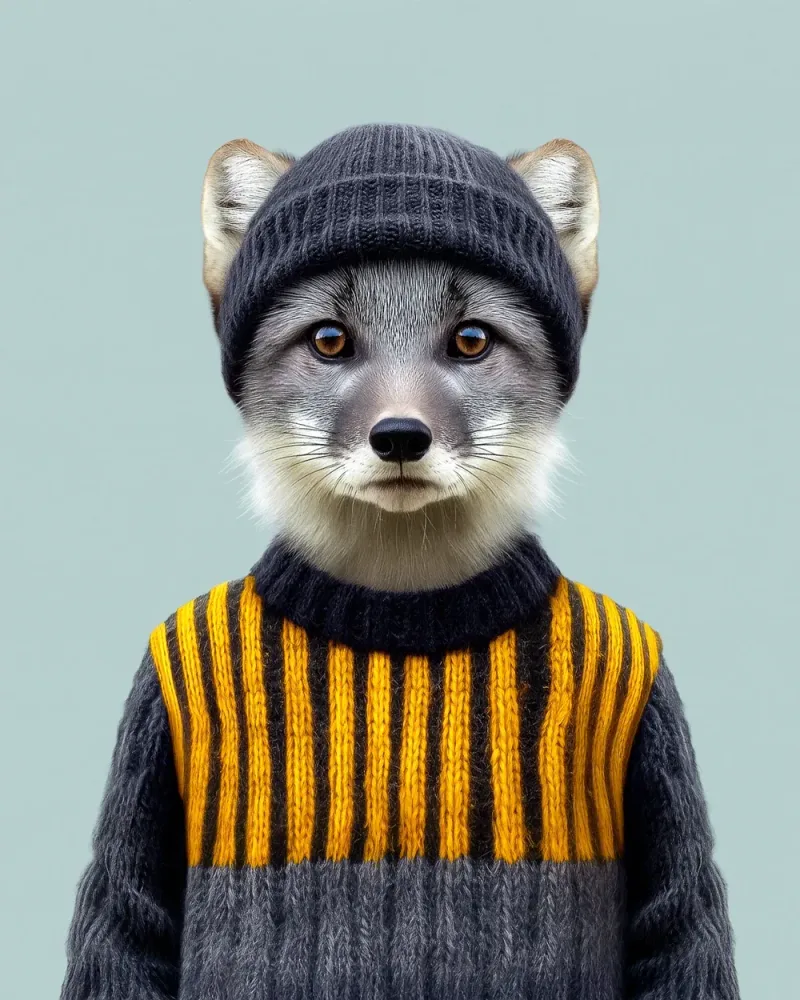
Otto, Arctic fox — Animal Kinhood portrait by Yago Partal AK · 22 N 69°42′ E 18°36′ Otto Kvaløya, NO PHOTO ©YP · 2026
Animal Kinhood · Wild animals No. 22 / 25 Episode · Otto
Vulpes lagopus

Otto.

Arctic fox

Cold teaches you to listen. Everything else is noise.
Add it to your Kinhood.Already part of your Kinhood.
Biography · Block 01 of 03 Arctic fox
Chapters · I–II–III

The story.

I
CH · 01 / 09

The six o'clock call

His mother's call came at six in the morning, right as he was stepping out of the cold-storage room. Otto, an Arctic fox, still had the minus-twenty cold clinging to his clothes when he learned that Ragnhild had died. He didn't ask for the day off. He sat on the locker-room bench and stayed still for forty minutes, hands in his pockets, then went back to his shift.

Ragnhild was the reindeer-Kin who had raised him in the afternoons in Hammerfest while his mother worked long shifts. She wasn't his mother, and no blood relation either. She was the older neighbour with the basement grow-lamp garden and the labelled jars, the one who taught him to tell one fermentation smell from another, and to stay quiet when silence was worth more than any explanation.

The following week he took the night bus to Hammerfest, brought three boxes down from the basement — seeds, preserves, a hardback notebook — and rode back with them in the seat beside him. He was twenty. It's the worst thing that's ever happened to him, and he still hasn't looked it in the eye.

II
CH · 02 / 09

Two weeks for a packet of cookies

The months after were the worst, though no one at the plant knew why. He stopped eating properly. He lost weight. He said nothing. The only one who noticed was a veteran from Kirkenes, two years from retirement, who started leaving a tub of soup in his locker. No note. No look. No sticking around to see if Otto ate it.

It took Otto two weeks to respond. He didn't say thank you — he wouldn't have known how — but one day a packet of cookies turned up in the other man's locker. Not a word from either side. The two of them carried on with their shifts as if nothing had happened, and things stayed that way until the veteran retired and left Otto the job with no ceremony at all: when there was a temperature problem or a stock issue, people started asking him.

That's where he learned something that put everything else inside him in order: care works when it doesn't demand anything back. The soup didn't ask for conversation, or gratitude, or for him to be feeling better by Monday. It was just there. He could take it or not take it, and that's exactly why he could take it. Ever since, he looks after people that same way, copying the gesture without knowing that's what he's doing.

III
CH · 03 / 09

A cardboard box and a place

At six years old, walking home from school, he found a dead Arctic-fox-Kin pup in the ditch. He didn't cry. He stood looking at it for a while, went home, got a cardboard box, and came back for it. Ragnhild helped him bury it behind the building.

She didn't tell him it was part of nature, or that everything passes. She told him: "Now you know where it is." Four words. Otto was six, and they lodged inside him the way a temperature does.

Ever since, he looks after the dead the same way he looks after anything else: by giving it a place. Bury it behind the building. Label the jar. Keep on his shelf what's no longer used but can't be thrown out either. Death, to him, isn't some abstract loss to talk about; it's a location. Something that was here and is now over there, and you know exactly where. The day Ragnhild died, the first thing he did with the boxes was find them a place.

There was more before all this. At three, his father went south to Bergen and stopped calling by the second winter; Otto barely remembers him, and what was left behind was a gap he decided not to look at. At eleven, his mother lost her job and they moved to Alta, with no basement and no Ragnhild, and he stopped talking to anyone outside class for nearly a year.

Voiceline · the character’s canonical quote Otto · Arctic fox
Hover to pause
Cold teaches you to listen. Everything else is noise. AK · 22 · Otto · Kvaløya 2025 Cold teaches you to listen. Everything else is noise. Voiceline · Vulpes lagopus Cold teaches you to listen. Everything else is noise. AK · 22 · Otto · Kvaløya 2025 Cold teaches you to listen. Everything else is noise. AK · 22 · Otto · Kvaløya 2025 Cold teaches you to listen. Everything else is noise. Voiceline · Vulpes lagopus Cold teaches you to listen. Everything else is noise. AK · 22 · Otto · Kvaløya 2025
§ 04 · Objects Open editions · everyday
10 pieces · Print on demand

Take Otto home.

Biography · Block 02 of 03 Roots
Chapters · IV–V–VI

The roots.

IV
CH · 04 / 09

The jars you don't throw away

On the basement shelf there are preserves of Ragnhild's that no longer get eaten. Expired, some of them years old. He doesn't throw them out. He lives alongside them the way he lives alongside the rock visible from the window: they're just there. Throwing them out would mean throwing out the place where she is, and that's a sum he can't make add up.

It's the closest Otto gets to grieving, and he does it without ever naming it. He doesn't talk about Ragnhild. He keeps her notebook in order, plants what she wrote down, keeps the jars that don't get eaten. The whole storeroom carries something of that: every labelled jar is a place for something, and some of those places exist for nothing more than not letting go of her.

Underneath runs something he's never told anyone. That if someone looked after him the way the veteran looked after him — without watching him, without demanding anything, leaving the soup and walking off — he'd probably fall apart. The work and the basement are enough for him, he says. He'll let people leave him food, but only if they don't make a scene of it. The day Ragnhild's jars finally go completely bad is a gap he hasn't had to look at yet.

V
CH · 05 / 09

The cold that keeps things in order

He wakes up at quarter past three in the morning with no alarm, every single day. It isn't discipline: his body decides for him. Porridge with peanut butter, black coffee, and his studded-tyre bike crossing the Sandnessundbrua bridge while Kvaløya is still dark and the wind smells of salt and diesel from the harbour.

At the plant he sorts cod, haddock and coalfish by quality and freshness, in a cold-storage room at minus twenty. He can tell a two-day-old fish from a four-day-old one by how the flesh gives under his thumb. He works there the way other people work in an office. The cold isn't a sacrifice; it's where he functions. It turns down a background noise inside him that only quiets when the temperature drops.

And he hears things. He hears the compressor that's about to fail before it fails, the thermostat when the room loses half a degree, the truck belt before it snaps. One morning he tilted his head in the middle of the floor and said "belt 3"; forty seconds later belt 3 jammed. At the plant they call him "ears," and he doesn't like being the one who predicts things. He'd rather people just listened.

VI
CH · 06 / 09

The care that asks for nothing

His way of loving someone is not saying it. A tub of soup that turns up in the shared fridge with no name on it. A sagging shelf that's fixed overnight and nobody knows by whom. Affection said out loud, to Otto, loses its truth; the kind that counts is the kind that asks for nothing back.

He doesn't argue. If he's cornered he says one short, precise sentence, without raising his voice, and walks off. A colleague once accused him of rearranging the boxes: "They were wrong," he said, and went into the cold room. He doesn't apologise when he's right. When he's wrong, he apologises by leaving something in the other person's locker, with no note.

The neighbourhood sees him as the one who turns up without you hearing him and leaves things sorted out: the soup that appeared, the shelf that holds, the seeds that came up. There's a huge gap between how little he thinks he matters and how much he actually does. If you tell him people care about him, he changes the subject.

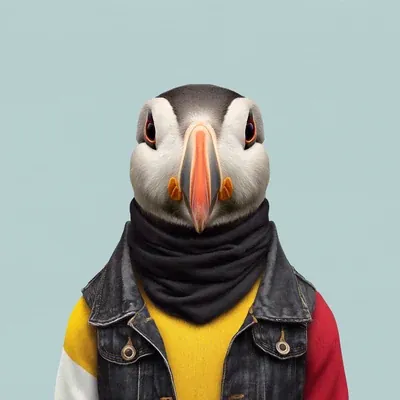
His bonds are few and long-distance, and that's how he likes them. Alek, a puffin-Kin from Reykjavík he met while giving him directions on the quay, sends him voice messages and passes through Tromsø every few months; they eat, they walk, they talk little. Faiz, a red-fox-Kin from Muscat he found while both were hunting down the same condenser on a repair forum, sends him voice clips that Otto listens to and answers by text. They understand each other in what goes unsaid: fathers who left, an ear that picks up too much. Neither one demands that he talk, and that's exactly why they're still around.

§ 05 · Limited editions fine art · numbered
02 editions

Two print runs. One same animal.

Black Edition No. 01 / 55 portrait on Hahnemühle Photo Rag Ultra Smooth · 305 g/m²
black oak frame · 305 g/m²
30 × 40 cm
Limited editions

Otto · Black Edition.

Paper
Hahnemühle Photo Rag Ultra Smooth · 305 g/m²
Print run
Signed and numbered · Edition of 55
Formats
60 × 80 · 30 × 40 cm
Frame
Black oak · museum mat
From 590 €
View Black edition
AK XL · Museum grade No. 01 / 30 Fuji Crystal Archive DP II
Diasec (matte acrylic 2 mm + Dibond 3 mm) · 6 mm
80 × 80 cm
Extra large

Otto · AK XL.

Support
Fuji Crystal Archive DP II · Diasec (matte acrylic 2 mm + Dibond 3 mm)
Quality
Museum grade · Edition of 30
Formats
120 × 120 · 80 × 80 cm
Mounting
Diasec · Dibond substructure
From 2 700 €
View XL edition
Biography · Block 03 of 03 Craft
Chapters · VII–VIII–IX

The present.

VII
CH · 07 / 09

The afternoons under the lamps

Before all this there were the childhood afternoons with Ragnhild. The grow-lamp garden in the Hammerfest basement, the jars lined up in rows, the shared silence that never made either of them uncomfortable. His mother worked processing shifts and came home late; Ragnhild had him with her in the meantime, and taught him more than any school did, without giving a single lecture.

That was the method: put the things in front of him and say nothing. Which is which. How it smells when it's good and how it smells when it's gone off. Where each jar goes and why it's labelled with a date. No spoken lessons at all. Otto watched, did, and something stuck.

Years later, at the plant, a veteran trained him the exact same way: putting the parts in front of him and waiting for him to say which was which. Otto learned in three weeks what took others months. He recognised the method without naming it, because it was Ragnhild's. Otto's entire way of being in the world — caring through actions, teaching with his hands, speaking only when necessary — comes from those afternoons with the lamps switched on and a reindeer-Kin who never explained a thing.

VIII
CH · 08 / 09

What turns up in the fridge

A system was born out of the three boxes from Hammerfest. Otto decided that Ragnhild's things couldn't just stay in his room, spoke to the building's elderly owner — a Kin in his seventies who barely uses the basement — and asked him for a corner. Within six months the corner was a storeroom: shelves made from pallet wood from the plant, second-hand glass jars, and a notebook by the door where people write down what they need and what they can offer.

It has no name. No website, no mission statement. Whenever anyone mentions "association" or "grant," Otto changes the subject. The idea that something that started with three boxes from a dead reindeer-Kin should end up a project with a logo and founding charter: no. The woman with the Tromsdalen garden taught him to sprout radishes under a lamp, and she's the only one he's ever invited downstairs. A biology student comes by for Arctic kale seeds.

He supplies half the neighbourhood and swears he doesn't need anyone. That if the plant closes he'll just go somewhere else and that's that. Both things are lies, and he half-knows it: his whole body tightens up at the mere thought of leaving the basement.

IX
CH · 09 / 09

Three boxes from the basement

He keeps Ragnhild's notebook in a zip bag inside a wooden box. Hardback, handwritten, planting tables with dates and the names of plants that can survive extreme cold. He has read it more times than anything else. It's the origin of everything he knows about seeds and preserves, and the origin of the whole storeroom. If someone touched it without permission, he doesn't know what he'd do.

He lent it out once, to the biology student. She returned it the next day with a thank-you note, and Otto kept the note too.

Every spring the urge to leave grows stronger; every autumn he buries it under preserves and routine. He vanishes for a day every few weeks, walks the Kvaløya coastline towards Rekvik or Kaldfjord with no destination, three hours or eight, and comes back soaked with his pockets full of stones he doesn't need. He leaves them on the windowsill, and when there are too many he returns some to the shore. Bringing something back from outside and giving it back is his domesticated version of nomadism, the small-scale version of an urge that never goes as far as it probably should. The plant doesn't ask where he went anymore. They wait, and he comes back.

> **Canonical quote:** The cold teaches you to listen, Otto says, and everything else is noise; that's why he looks after half the community by leaving soup with no note, and plants every spring what Ragnhild wrote down by hand.

§ 06 · Connected souls 03 canonical bonds
Animal Kinhood

Connected souls.

§ 07 · Species file Vulpes lagopus

About the arctic fox.

Classification
  1. Animalia
  2. Chordata
  3. MammaliaMammals
  4. Carnivora
  5. Canidae
Vulpes lagopus (Linnaeus, 1758)
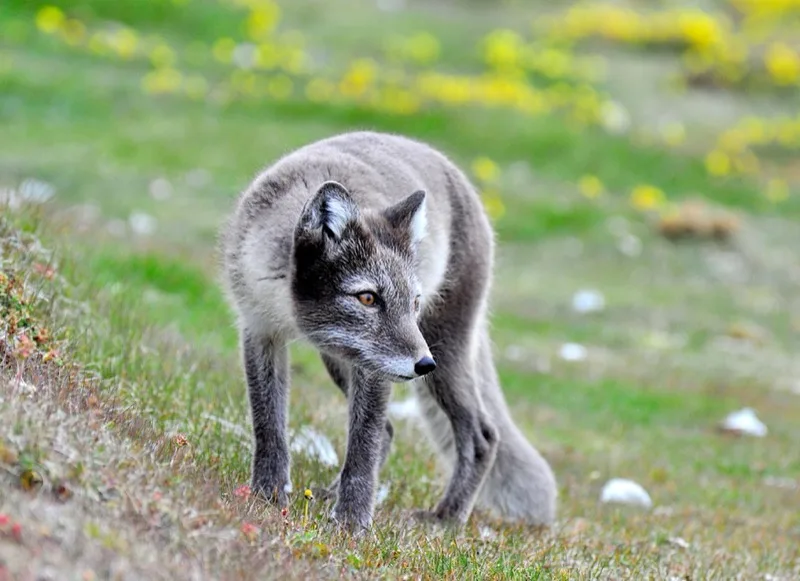
Arctic fox (Vulpes lagopus) in the wild
The real animal · Vulpes lagopus
Habitat
Circumpolar arctic and alpine tundra: coasts and interior of Norway, Sweden, Finland, Russia, Canada, Alaska, Greenland, Iceland and Svalbard. It is Iceland's only native land mammal.
Diet
Opportunistic omnivore. Staples: lemmings and voles, which it locates under snow by sound and captures with a vertical head-first pounce. Supplemented with seabirds, eggs, berries, carrion and polar bear kill remains.
Lifespan
3-6 years in the wild / up to 14 years in captivity.
Weight
1.4-9 kg; body length 46-68 cm with a 28-43 cm tail. Weight can increase by 50% in autumn through subcutaneous fat accumulation.
Adaptation
Its winter coat has the highest insulating capacity of any mammal, with 70% ultrafine underfur; the paws are covered in dense fur (hence the scientific name lagopus, hare-footed), unique among canids. It holds 38 °C without shivering down to -70 °C.
Record
A winter migration of 3,506 km in 76 days from Svalbard to northern Canada, with an average speed of 46 km/day; recorded by the Norwegian Polar Institute in 2019.

Conservation status

Global (IUCN)
Least Concern
Where it lives
The situation in the Scandinavian Peninsula is radically different: Critically Endangered in Norway and Sweden, functionally extinct in Finland. The total Scandinavian population is estimated at fewer than 200-300 adults.
Population
Estimated at several hundred thousand individuals globally, with stable populations in the Canadian, Russian, Greenlandic and Alaskan Arctic.
View the IUCN Red List page

Main threats

  1. Climate change: shrinking sea ice, disruption of lemming cycles, summer heat stress episodes.
  2. Northward expansion of the red fox, which displaces the arctic fox from its dens and acts as a rabies vector.
  3. Hybridisation with the red fox in overlap zones, with risk of genetic dilution.
  4. Prey decline: falling populations of lemmings and seabirds linked to warming.
The Norwegian captive breeding and reintroduction programme, launched in 2005 by NINA, has grown the population from around 50 individuals to more than 300 in two decades.

Did you know…?

01
Cold without stress down to -70 °C

The arctic fox does not shiver until temperatures drop to -70 °C, thanks to a coat with 70% fine underfur and fur-covered paws, unique among canids. It can live twelve to fifteen years and travel thousands of kilometres in a single season.

02
Green gardens on the tundra

The dens enrich the surrounding soil with urine, faeces and prey remains, generating between 71% and 1,195% more nutrients than adjacent tundra and 2.8 times more plant biomass. These oases are visible from the air as green patches against the white landscape.

03
A magnetic compass while hunting

Recent research (Cornell, 2024) suggests that the arctic fox orients its hunting pounces according to the Earth's magnetic field, improving its accuracy when diving head-first into snow to catch lemmings detected by ear alone.

04
Seasonal coat change

97-99% of the continental population moults twice a year: white in winter for snow camouflage, and grey-brown in summer. The blue morph dominates in Iceland (up to 70% of individuals) and is rare on the continent.

05
Multigenerational dens

Tunnel complexes, with up to a hundred entrances, are used and extended over decades or centuries. A single system may have been inhabited by hundreds of generations.

06
The aurora borealis in Finnish folklore

In Finnish, the aurora borealis is called revontulet, fox fire. Sami and Finnish legend says the arctic fox ran so fast across the tundra that its tail struck sparks of snow against the mountains.

§ 08 · Conservation four programs · verified
Arctic fox

Help protect this species.

Every purchase helps, but a direct donation does more. Four NGOs with specific programs verified for this species.

No. 01 / 04

NINA.

Norsk Institutt for Naturforskning

Has led the Norwegian captive breeding and reintroduction programme for the Scandinavian arctic fox since 2005; the Norwegian population has grown from about 50 breeding adults to more than 300 in two decades.

Donate to NINA
No. 02 / 04

WWF.

World Wildlife Fund

Works to protect the arctic fox's Arctic habitat against climate change through emissions-reduction campaigns and monitoring projects.

Donate to WWF
No. 03 / 04

Melrakkasetur.

Arctic Fox Centre of Iceland

Research and environmental education centre in Súðavík (Iceland) dedicated to monitoring the country's only arctic fox population.

Donate to Melrakkasetur
No. 04 / 04

Fjällräven.

Fjällräven Arctic Fox Initiative

Swedish outdoor gear company that funds the Save the Arctic Fox project in partnership with Stockholm University.

Donate to Fjällräven
Animal Kinhood · 25 characters

Twenty-five names. Twenty-five stories. Twenty-five personalities. One same project.

Full catalogue · Drop 01 — Q3 2026 Explore Animal Kinhood